
Organisations have poured many resources into circular economy initiatives, yet most still struggle to demonstrate tangible results or benchmark performance against peers.
The Global Circularity Protocol for Business (GCP) introduces one of the first globally coordinated frameworks for measuring, managing and communicating circular performance across value chains, addressing the fragmented guidance that has long stalled progress.
This strategic brief unpacks what Protocol delivers, how it differs from the existing frameworks and practical implementation steps for organisations navigating circular economy regulations.
The measurement problem holding circularity back
Circularity faces multiple barriers, from leadership buy-in and financial models, to technical innovation. We have explored these challenges in depth in our article “Why circularity isn’t scaling and what we should do about it” and our webinar “Circularity, the (only) winning business model” with experts from Danfoss and ReMarkable.
This article addresses a different, equally critical barrier: the measurement infrastructure itself. Even when organisations have strong intent, capital and solutions, they lack the metrics needed to demonstrate circular performance in ways that investors recognise, regulators accept, and value chain partners can benchmark.
Why circularity isn’t scaling and what we should do about it
Despite innovation and policy pressure, most companies hit a ceiling in circularity. Discover why scaling depends less on technology and more on solving the human and financial barriers first.
-> Read the full article here

Limitations of existing circularity frameworks
The landscape analysis conducted for the Global Circularity Protocol reveals some systemic gaps in current standards, frameworks and reporting practices that prevent circularity from scaling. Below, we briefly touch on some of the limitations that shaped the considerations for the Protocol.
Firstly, frameworks focus on the wrong parts of the system.
Today’s dominant metrics remain heavily end‑of‑life oriented, double clicking on recycling rates, waste volumes and recovery percentages. These are easy to track, but they overlook the strategies with the greatest potential for resource decoupling, value creation and value retention.
Secondly, indicators miss the full picture. Current frameworks rarely link circular performance to climate, water, pollution, land-use and social impacts. They often omit avoided impacts (e.g., extraction or emissions) and fail to measure social outcomes (e.g., job quality, impacts on informal workers). Consequently, organisations cannot fully assess circularity as part of a just transition.
Lastly, fragmented definitions undermine transparency. A major barrier identified in the GCP research is the lack of harmonisation across regions, sectors and standards. Definitions of circular inflow/outflow, lifetime, renewable content, and recyclability vary widely. Misaligned frameworks slow adoption and make value chain collaboration difficult.
In a nutshell, the current measurement infrastructure does not reflect the real circular economy. These gaps are what the Global Circularity Protocol was designed to address.
The 5-stage journey of the Global Circularity Protocol
Stage 1: Frame your objectives
Stage 2: Prepare your GCP circular performance and impact assessment
Stage 3: Measure your circular performance and impact
Stage 4: Manage your circular performance and impact
Stage 5: Communicate with external stakeholders
You can learn more about each stage of the Global Circularity Protocol here.
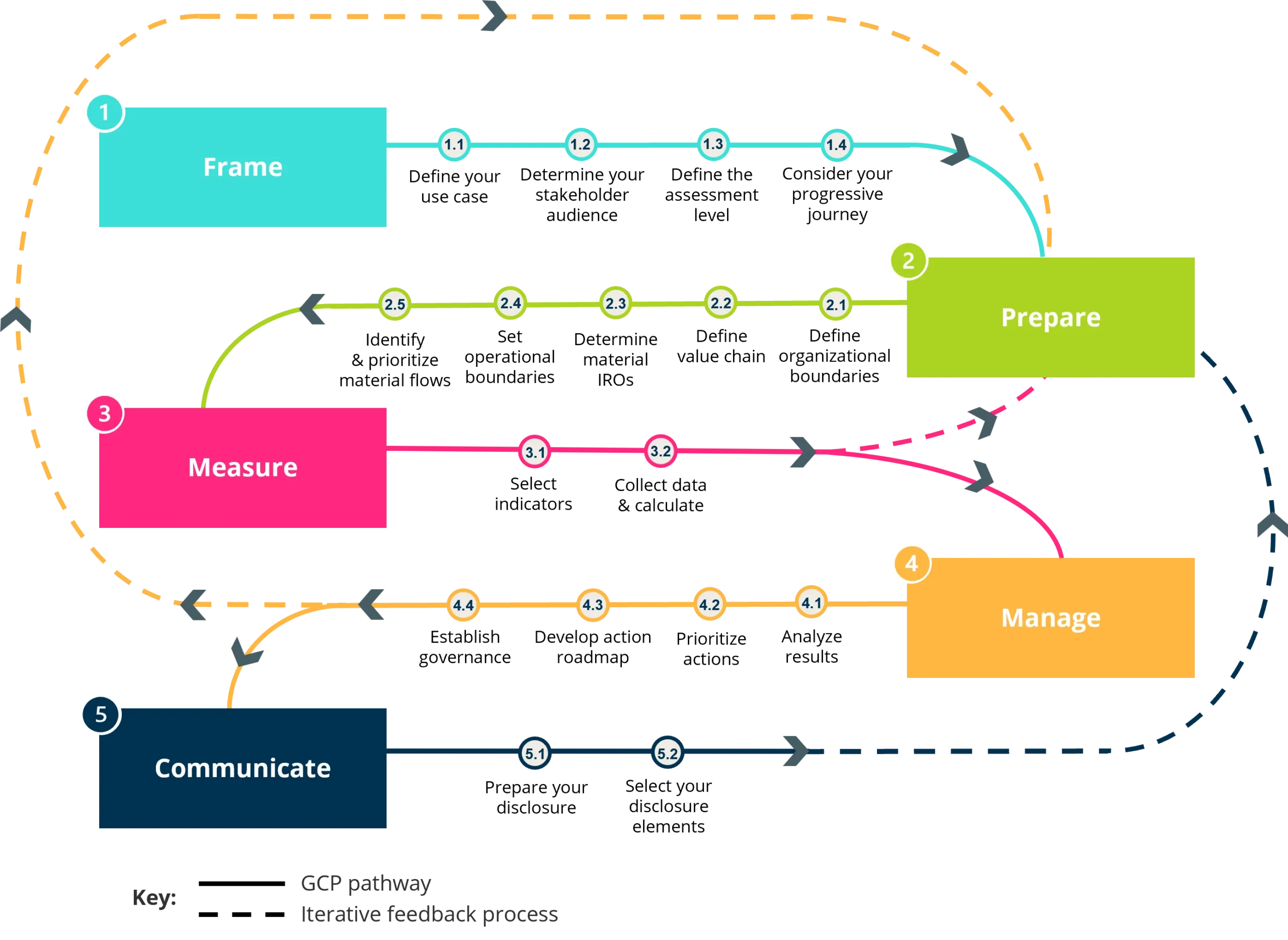
Figure 1: Overview of the Circularity Global Protocol user journey
Where the GCP fits in the current regulatory landscape
Teams already working with circularity rightfully question whether the Protocol represents genuine progress or merely adds to the 16+ existing circularity-related frameworks. These indeed shape how companies work with compliance, strategy and disclosure, yet they serve different purposes.
Binding EU regulations, such as the Ecodesign for Sustainable Products Regulation (ESPR) and the Packaging and Packaging Waste Directive (PPWR), set mandatory targets for product design, material efficiency, and recycling. They are compliance-driven, though limited to sector-specific obligations.
Measurement and target‑setting frameworks, such as WBCSD’s Circular Transition Indicators (CTI) and SBTN‘s nature target-setting methods, offer guidance on circular strategies but lack harmonised, verifiable metrics for cross-organisational comparison.
Disclosure and reporting standards, including GRI, CDP and ISO 14097, focus on transparency and reporting. They standardise information, but do not drive actionable measurement or decision-making.
The Protocol’s distinct approach
The Global Circularity Protocol fills a critical gap across this landscape by providing the measurement infrastructure that makes circularity comparable, verifiable, and decision-relevant. Rather than replacing existing frameworks, it enables them to:
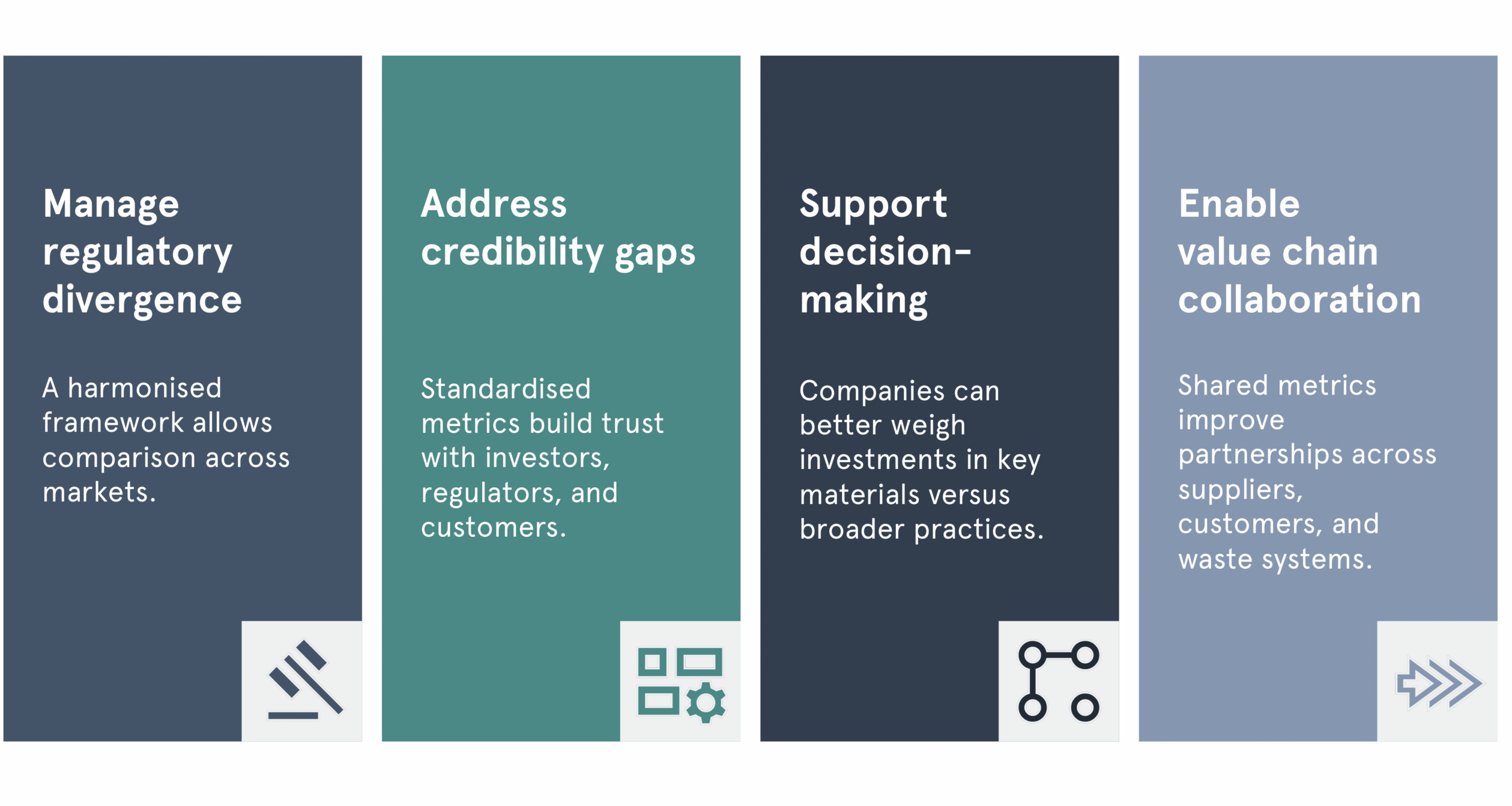
Manage regulatory divergence
Different jurisdictions have diverging requirements for measurement and disclosure.
This harmonised framework can enable comparison across markets.
Address credibility gaps
Standardised, verifiable metrics can improve trust among investors, regulators, and customers. Companies adopting the Protocol may accelerate circular maturity, but success depends on transparency and consistent application.
Support strategic decision-making
The GCP clarifies the relative impact of different circular initiatives, enabling companies to weigh investments in strategic materials versus broader circular practices.
Enable value chain collaboration
Shared metrics facilitate partnerships across suppliers, customers, and waste management systems, supporting ecosystem-level circular outcomes rather than isolated projects.
Limitations and implementation challenges
The Protocol is unfortunately not a plug-and-play solution. Its effectiveness depends on each organisation’s implementation choices. Organisations may face practical challenges including:
-
Resource requirements for comprehensive data collection
-
Risk of focusing on easily measured metrics rather than material ones
-
Need for interpretive work to translate outputs into strategic decisions
These challenges demand specialised support, and organisations engaging early with the Protocol can move up the learning curve while others still work out where to start.

A step-by-step guide to operationalising the Global Circularity Protocol
The Global Circularity Protocol’s actual value lies in how organisations interpret and apply it. An effective implementation roadmap uses the framework to inform decisions, balance trade-offs, and then embed circularity into business strategy.
Below, we outline a pragmatic sequence we use when advising organisations on integrating new circular frameworks such as the GCP.
1. Start by setting your circularity ambition
Organisations should begin with a clear articulation of their circularity ambition before selecting metrics or applying the Protocol. This includes defining the intended depth of change, the scope of products or value chains covered, the time horizon, and the role circularity is expected to play in value creation, risk management, and regulatory readiness.
In practice, ambition could be informed by frameworks such as the WBCSD CTI, alongside double materiality assessments (DMA) under the CSRD.
Explicit ambition-setting prevents the Protocol from being applied as a purely technical or compliance-driven tool and ensures that subsequent measurement focuses on relevant outcomes rather than what is easiest to quantify.
2. Identify where circularity is financially and impact-material
Assess where circularity is financially and impact-material to the organisation. This involves linking circularity topics to regulatory exposure, material and energy costs, supply risks, and stakeholder expectations across the value chain. Double materiality assessments under ESRS provide a structured basis for prioritisation. They help distinguish between circular actions with limited relevance and those that materially affect performance, resilience, or compliance.
3. Test the Protocol through targeted pilots before full rollout
Testing the Protocol within specific product lines reveals data gaps and capability needs without overextending resources. A consumer electronics manufacturer, for example, might begin with a flagship product facing regulatory pressure before expanding to a full portfolio assessment.
Pilots should focus on areas with high material intensity, regulatory scrutiny, or strategic importance.
4. Integrate circularity with existing reporting and data systems
To reduce duplication and improve consistency, embed the Protocol within systems already used for sustainability, lifecycle and resource reporting.
Alignment with CSRD reporting structures and EU Taxonomy requirements is particularly important where circularity metrics inform regulatory disclosures or investment decisions. Additionally, data collection and management should build on processes already used for GHG accounting and lifecycle assessment processes (LCA). Creating parallel measurement systems increases effort without improving the quality or usefulness of the information.
5. Enable circular outcomes through value chain collaboration
Many circularity levers sit outside direct organisational control. Progress depends on collaboration with suppliers, customers and end-of-life partners across sourcing, design and recovery.
Shared definitions, metrics and data exchange are essential for effective coordination. Beyond that, clear roles and aligned incentives are required to translate collaboration into measurable outcomes.
6. Treat the Protocol as diagnostic for strategy & investment decisions
The GCP outputs should directly feed strategic planning cycles, R&D prioritisation and investment screening. Measurement without strategic integration wastes the exercise. Used diagnostically, the Protocol highlights trade-offs and directs resources toward circular interventions with the highest business and impact returns.

Want to get started or go further?
The Global Circularity Protocol is a bridge from disjointed circularity pilots to enterprise-wide transformation. Yet no framework, however harmonised, enacts change by fiat. It still demands clear entry points, smart sequencing and an ambition calibrated against operational reality.
Nordic Sustainability helps leadership teams translate the Protocol’s framework into an actionable strategy. Our bespoke GCP integration service, launching in early 2026, is designed to support teams move from “measuring” to “mastering” circularity: building internal capabilities, integrating metrics into R&D cycles, and positioning your performance to attract green capital.
Ready to lead the transition? To explore how the GCP fits into your future strategy, reach out to Minna Shukri, Circularity Practice Lead: msh@nordicsustainability.com
References
- Ellen McArthur Foundation, Circular Economy Reporting, 2024
- Packaging and Packaging Waste Regulation (PPWR), 2025
- Ramboll, Is resource autonomy the new circular economy?, 2025
- The Global Circularity Protocol for Business version 1.0, 2025
- A GCP Landscape analysis, 2025
- Circle Economy’s Global Circularity Gap Report, 2025
- WBCSD’s Circular Transition Indicators (CTI), 2023
- SBTN’s nature target-setting methods, 2023
- The Global Reporting Initiative (GRI)
- The Carbon Disclosure Project (CDP)
- ISO 14097: Greenhouse Gas Management Framework, 2021
Read more
- Danfoss, ReMarkable and Nordic Sustainability on circularity, 2025
- Why circularity isn’t scaling – and what we should do about it, 2025
- Our explainer on the Ecodesign for Sustainable Products Regulation (ESPR) 2025
- Our guide on how to implement a Double Materiality Assessment, 2024
Author details
Linh Pham
Marketing and Communications Lead