A new chapter begins for the European Sustainability Reporting Standards (ESRS). The amended standards introduce extensive changes, and there is much to unpack. This article does not aim to be exhaustive. Instead, it offers a snapshot of the amendments we consider most critical for Wave 1 companies.
Overall, revisions reduce reporting burden by removing over 60% of mandatory datapoints, while improving clarity and streamlining several disclosure requirements. The changes are expected to be adopted mid-2026, giving sustainability teams a window to strengthen their data systems and refocus on relevant climate and social metrics.
Why the amended ESRS matter now
The European Commission is expected to adopt the amended ESRS via a Delegated Act only around mid‑2026. Nevertheless, the technical advice from EFRAG is already shaping how Wave 1 companies plan their 2026–2027 reporting roadmaps.
>The revised ESRS applies starting January 1st next year, and therefore, reporting teams need to now understand how they need to change their approach.
From our perspective, the headline 57–61% reduction in mandatory datapoints and removal of all voluntary datapoints should be interpreted as a redistribution of effort.
It is definitely not a permission slip to scale back ambition. Investors, clients and other stakeholders will continue to expect coherent, comparable information on climate, biodiversity and social topics.
Phase-ins for Wave 1: Key omissions until FY27-FY30
The amended ESRS introduce phase‑in options. Wave 1 companies can omit selected disclosures temporarily, especially in new or data‑poor areas.
Used strategically, these reliefs allow companies to mature methodologies and improve reporting systems.

Key phase-ins for Wave 1 undertakings include:
- Full omission of disclosure requirements under E4 Biodiversity and Ecosystems, S2 Workers in the Value Chain, S3 Affected Communities and S4 Consumers and End-users until FY27.
- Omission of qualitative disclosure requirements related to anticipated financial effects under ESRS 2 General Requirements and E1 Climate Change, with the exception of the carrying amount and percentage of assets at material physical and transition risk, until FY27, and omission of the quantitative anticipated financial effects disclosures under the same standards until FY30.
- Omission of quantitative information on substances of concern under E2 Pollution until FY30.
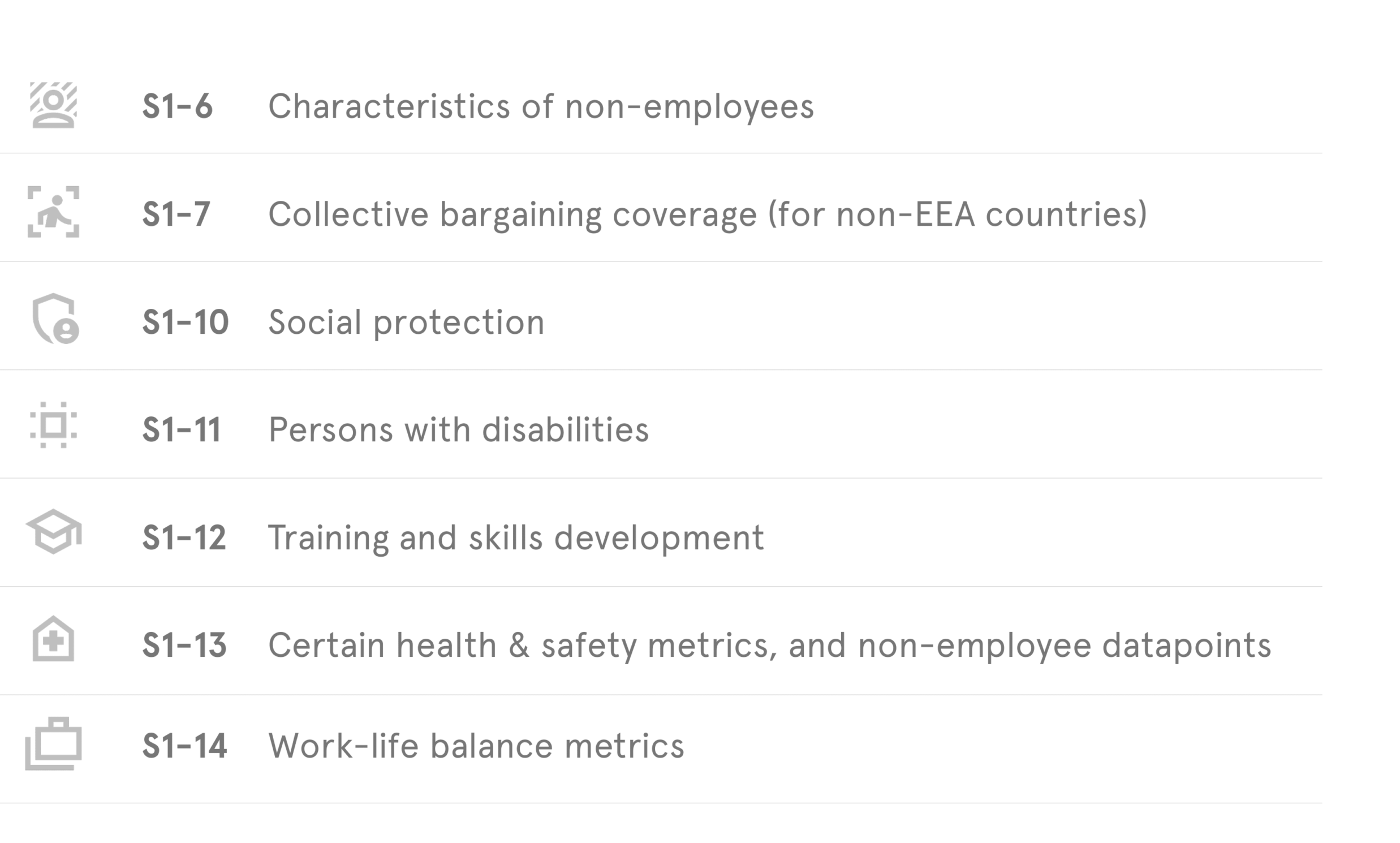
- A significant number of metrics related to S1 Own Workforce can be omitted until FY27. These include:
Phase-ins for non-Wave-1 companies and future first-time reporters will be determined separately by the European Commission.
New and revised ESRS requirements you cannot ignore
Several datapoints have been deleted or consolidated. However, some areas introduce new or refined metrics that require attention.

E2 Pollution
The amended ESRS revise metrics on substances of concern (SOC) and very high concern (SVHC). They now include separate rules for manufacturers, importers, and non-chemical companies that are users of substances. Simplified metrics were added for non-chemical users. SVHC disclosures now apply to components or articles in procured or sold products. The regulation sets a 0.1% threshold according to REACH.
E3 Water
Metrics on water withdrawal and water discharges have been made mandatory; metrics on water intensity have been removed.
E4 Biodiversity and Ecosystems
The voluntary datapoints on biodiversity transition plans disappear, replaced by a mandatory datapoint to disclose key features of the transition plan if the company has one in place and it is made public.
E5 Resource Use and Circular Economy
The percentage of total weight of critical and strategic raw materials has been added as a metric under resource inflows, with Annex II providing relevant definitions. The percentage and/or total weight of waste for which the final destination is unknown has been added as a metric.
 For S1 Own Workforce, the most notable change is the revised methodology for adequate wages (S1-9) outside the EU. The standard now anchors adequacy assessments in the ILO Principles for Estimating a Living Wage, pushing multinationals to go beyond statutory minimum wage benchmarks in non‑EU markets. For EU‑headquartered groups with extensive global operations, this will require close collaboration with HR and local entities to develop consistent, defensible methodologies.
Streamlined DMA and information materiality under the amended ESRS
Perhaps the most strategically important shift in the amended ESRS is in the Double Materiality Assessment (DMA). The revisions clarify concepts and streamline processes. They also introduce a “top-down” approach. This approach reduces complexity without diluting the underlying principle.
Key developments include:
- A top‑down approach that allows companies to start from strategy and business model, and in some cases conclude on topic materiality without exhaustive scoring of every impact, risk and opportunity. Quantitative scoring is reserved for areas where the materiality of impacts, risks and opportunities is not evident, reducing unnecessary analysis on clearly material or non‑material issues.
- Clearer guidance on how to assess actual and potential impacts, including the role of prevention, mitigation and remediation: severity assessments should reflect mitigation achieved in the current reporting period, but should not consider remediation of impacts that arise during that same period.
- For potential impacts, only already‑implemented policies and actions that can reasonably be expected to reduce severity or likelihood may be factored in, discouraging overly optimistic assumptions based on planned measures.
Positive impacts, a recurring challenge for Wave 1 reporters, receive more explicit guidance. The amended ESRS clarify that reported positive impacts must go beyond compliance or mitigation of a company’s own negative impacts, a shift that will likely temper some of the more promotional narratives seen in early CSRD drafts.
Finally, the notion of information materiality is extended. It now applies not only to topical E, S and G standards but also to ESRS 2 General Requirements. In practice, this means datapoints must be disclosed only where they are material to understanding the impacts, risks and opportunities of a topic; nothing outside that scope is required, reinforcing the link between the DMA and the final content of the sustainability statement.
For reporting teams, this is an opportunity to replace check‑the‑box exercises with a decision‑oriented materiality framework, while also enabling leaner documentation where detailed assessments are not required for each impact, risk or opportunity.
ESRS burden-reduction reliefs for value chains
Several additional reliefs aim to align effort with the availability and reliability of data, especially across complex value chains. These can be powerful tools if used transparently and with a clear roadmap for improving data collection.
Notable elements include:
- Companies may use actual value chain data or estimates, “depending on practicability and reliability,” and the previous strong emphasis on direct data from all counterparties is eased, acknowledging current limitations in upstream and downstream data.
- Metrics can cover a partial scope where reliable information cannot be obtained without undue cost or effort, provided the company explains the scope, rationale, and how coverage will improve over time.
- Activities may be excluded from metric calculations if they are not significant drivers of the relevant impacts, risks and opportunities, with the use of this relief clearly disclosed.
- Joint operations without operational control can be excluded from environmental metrics, again (except E1 climate change), with disclosure of the relief and plans to enhance coverage and data quality.
- “Undue cost or effort” is explicitly linked to the DMA, value chain data and anticipated financial effects, and must be reassessed annually. This creates an expectation that data availability, and therefore disclosure scope, will expand over time, something assurance providers and investors are likely to monitor closely.

So, what should reporting teams do next?
To make the most of this shift ahead of the 2027 application date, several actions stand out.
- Map current data gaps against phase-ins and new metrics
Identify which deleted datapoints are genuinely gone and which have effectively moved into ESRS 2 or been consolidated, to avoid assuming effort reductions that are not there. Use this mapping to prioritise development in high‑leverage areas such as climate risk, critical raw materials, water and wage adequacy. - Update or design DMA processes for a top-down approach and information materiality
Update materiality methodologies to leverage the new top‑down approach while maintaining evidence‑based analysis where needed. Document how impact, risk and opportunity assessments feed directly into information materiality decisions for ESRS 2 and topical standards. - Strengthen cross‑functional collaboration on new metrics
Engage procurement, product stewardship, HR and finance departments around new and revised datapoints, from SVHC disclosures and critical raw materials to living wage methodologies. Align these efforts with existing initiatives on supply‑chain transparency, just transition and circularity to avoid parallel reporting workstreams.
Want to get started or get further?
Nordic Sustainability has successfully supported leading companies across Europe build robust reporting structures that drive compliance, strategic decision-making, and long-term resilience. Reach out to our Managing Partner, Anniina Kristinsson, at akr@nordicsustainability.com to get started.
Read more
- The ESRS Knowledge Hub, a centralised platform to guide implementation
- The European Commission on the Omnibus Package
- Ørsted and Nykredit on how the new legislative changes impact their work
- A webinar on creating an ESRS-aligned sustainability strategy
- A step-by-step guide on how to implement a Double Materiality Assessment
- 7 steps to develop a robust Climate Transition Plan

The latest in European regulatory news
Sustainability reporting is evolving beyond compliance, especially as CSRD scope narrows. Read our companion article on the value of sustainability reporting to understand why many companies continue reporting — and what they gain from it.
Author details
Saara Salonoja
Associate Manager