The Directive on Empowering Consumers for the Green Transition (EmpCo) introduces strict rules against greenwashing, protecting consumers from vague and misleading environmental claims. By 27 September 2026, companies must be able to substantiate the consumer-facing sustainability claims they make.
In this article we give an introduction to the directive and outline some of the steps that companies should take to prepare.
EmpCo in short
This directive introduces new requirements for companies to substantiate their environmental claims and stricter rules for the use of sustainability labels. It amends the existing Unfair Commercial Practices Directive (UCPD) and Consumer Rights Directive (CRD), which have already been implemented in the EU member states. The aim is to enable consumers to make informed purchasing decisions, leading to more sustainable consumption.
Who does it apply to?
The EmpCo directive applies to all companies selling directly or supplying (e.g. through a third-party retailer) products or services to consumers in the EU. Although the regulation targets B2C companies, the effects will likely trickle down to the B2B sector as well through increased demand for data linked to environmental claims. For example, companies in scope may need to develop or further improve their organisational and product carbon footprint calculations, leading to data requests for their suppliers.
It is also crucial to note that EU member states may choose to apply the requirements in a B2B context as well when implementing the legislation.
What is required from companies under the new rules?
- All environmental claims need to be substantiated with recognised scientific evidence
- Generic terms (e.g. ‘eco-friendly’, ‘sustainable’, ‘responsible’, ‘energy efficient’) should be avoided unless the exceptional environmental performance can be proven
- Only certified or government-backed sustainability labels can be used
- When making claims related to the durability, repairability and recyclability of products, clear and comparable data needs to be made available to consumers
- Claims related to future environmental performance need to be verified by a third-party expert, supported by clear commitments or targets, and backed by a detailed and credible implementation plan (e.g. a climate transition plan including the allocated resources should be in place when publicly communicating the company’s climate goals)
Which communications are in scope?
The new rules will apply to external communications that relate to the promotion, sale or supply of a product or service to consumers. This includes product labels, advertisements, printed marketing materials, website content and social media posts.
While product-related communications such as labelling and advertising are at the core of the directive, companies in scope should pay close attention to other sustainability-related external content as well. Website content outlining the company’s approach to sustainability, including overall ambitions and commitments or strategies may also be considered as consumer-facing.
An important exemption is corporate sustainability reporting, including CSRD disclosures. According to the European Commission, reports are typically not in scope as they are often mandatory and not considered as B2C commercial practices. Companies should, however, be cautious of using this information elsewhere in their communications.
How should companies prepare?
A critical first step is to gain an in-depth understanding of how the requirements in the EmpCo directive will be applied in your company’s context. Discuss with your legal team and auditors, map all consumer products or product ranges, and identify the materials and content that can be considered consumer-facing. Importantly, assess also the EU member states that consumers products are sold or supplied in and whether there are differences in how the directive has been implemented on a national level.
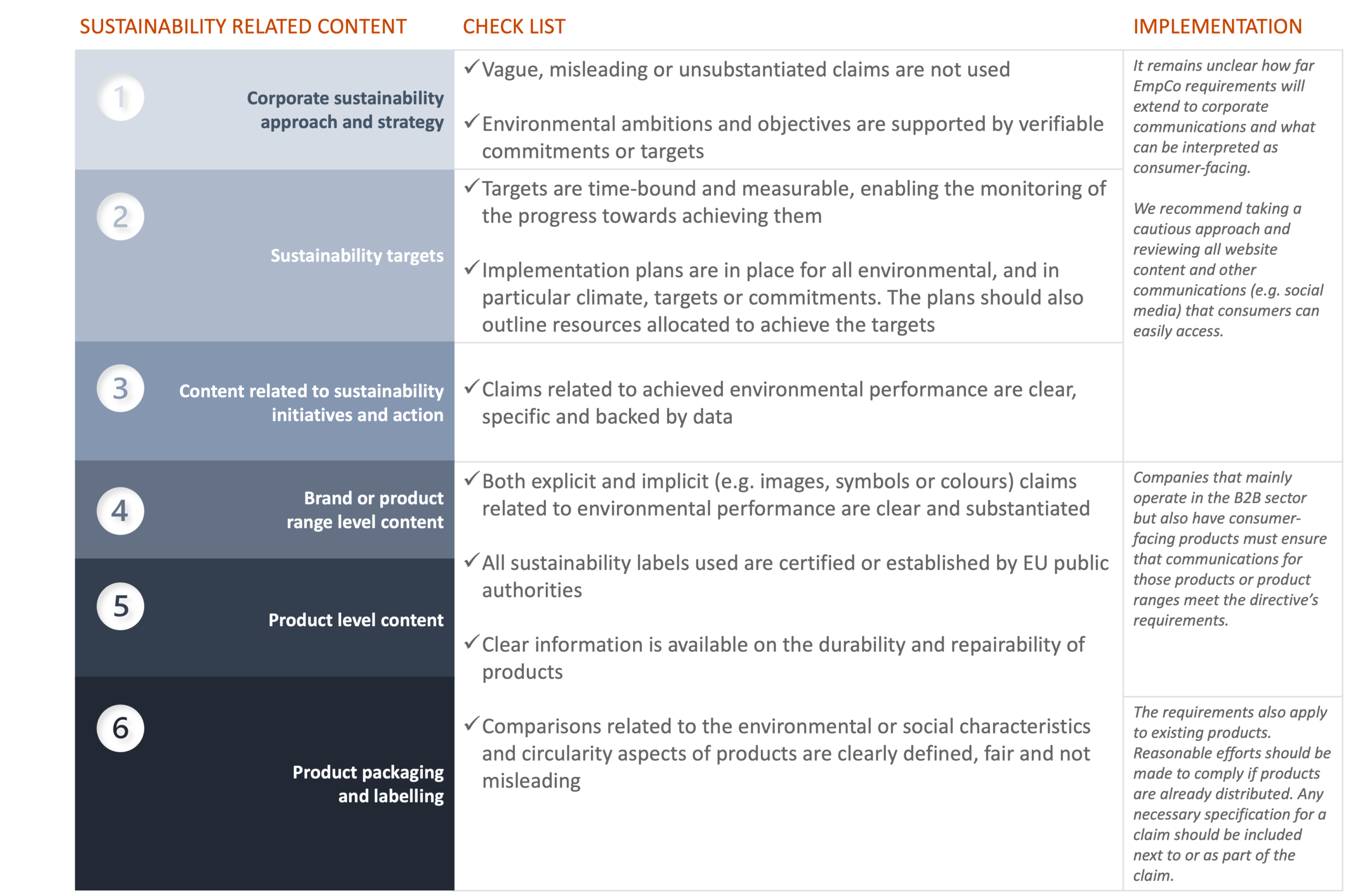
Once you have a clear view of the scope, we recommend starting with the following checklist that outlines what to look out for in different types of sustainability content.
Want to get started?
If you organisation is interested in learning more about the Empowering Consumers for the Green Transition directive, or looking for support in preparing for the upcoming changes, reach out to our experts:
Saara Salonoja, Associate Manager: ssa@nordicsustainability.com
Minna Shukri, Associate Team lead for Climate & Circularity: msh@nordicsustainability.com
Author details
Saara Salonoja
Associate Manager