
Physical climate risks are no longer minor events. Heatwaves, droughts, and floods are becoming more frequent, more severe, and more widespread.
In Europe alone, the financial impacts of extreme weather and climatic events are on average increasing by 74% year on year, with events in 2024 costing European companies €40bn.
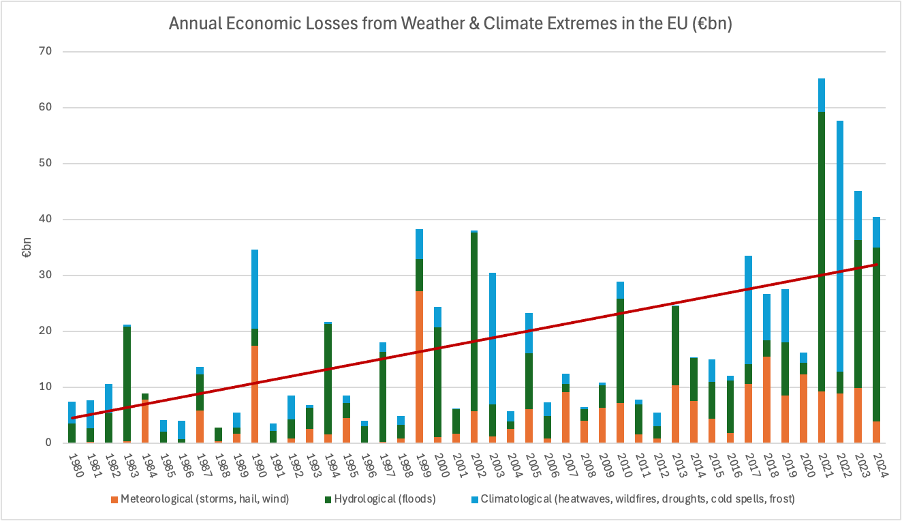
Source: EEA
These impacts are growing at an alarming rate, but are mostly looking at European companies and their own operations. When supply chains can stretch to all corners of the globe, the impacts can become exponential and are often underestimated or overlooked completely. In this article, we look at how to identify and manage them.
How climate risk disrupts business operations
Climate risk assessments have tended to focus on a company’s own operations. That’s a reasonable place to start, but can create a false sense of security if few material risks are found there.
Supply chains are typically long, complex, and spread across multiple geographies, which means exposure to physical climate risks accumulates well beyond what any single site assessment will catch.
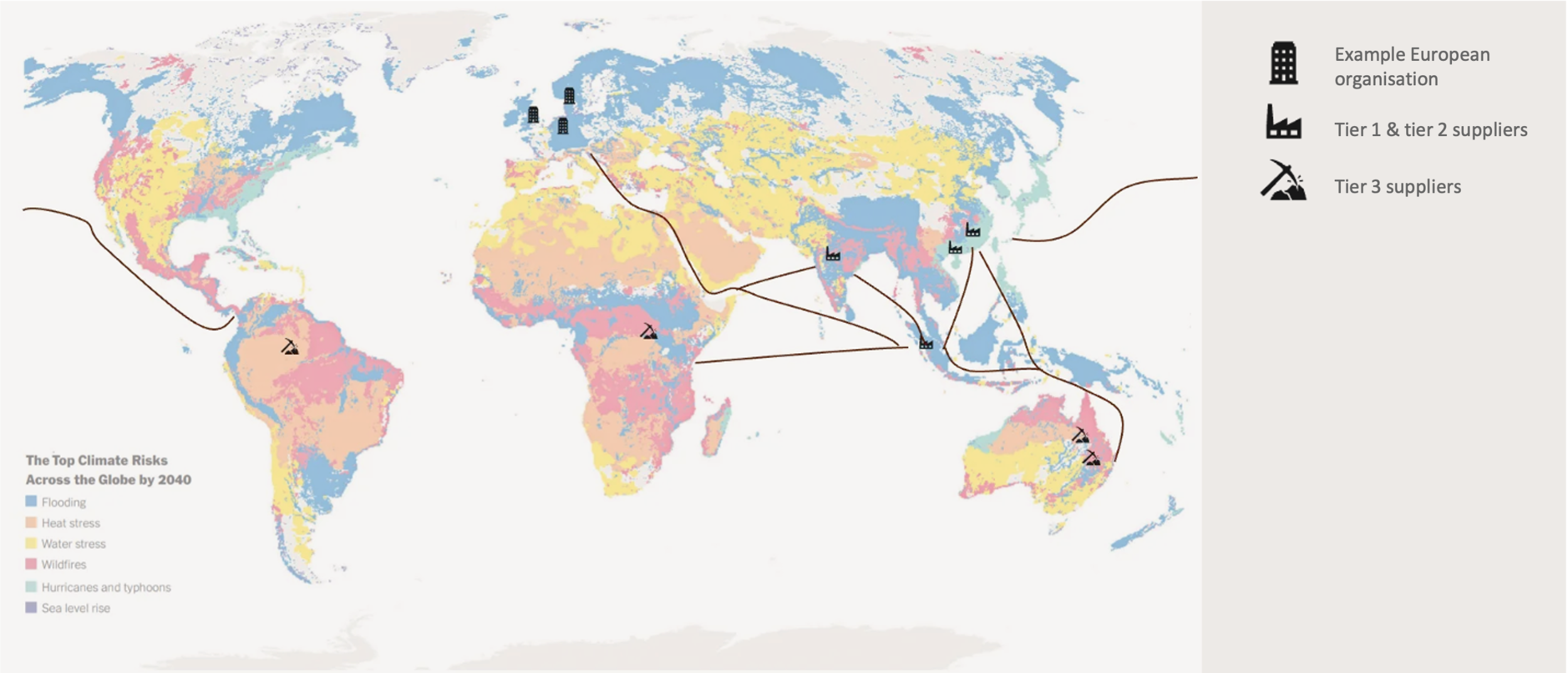
Delays, inventory losses, and supply shortages all translate directly into cost. Two recent examples illustrate how quickly disruption can travel up a supply chain.
In 2022, droughts across China caused hydroelectric power shortages that shut down factories supplying components to Toyota, Foxconn, and Tesla for six days. And with roughly 80% of logistics moving by sea, choke points become critical: the Panama Canal region received 41% less rainfall than normal in 2023, threatening to disrupt the US$270 billion worth of cargo that flows through the Atlantic-Pacific shortcut annually.
Procuring from suppliers without an understanding of their climate exposure can leave organisations absorbing the impacts of risks that originate far down the supply chain.
Resilience planning as an opportunity to embed climate risk
Geopolitical uncertainty has pushed resilience up the corporate agenda. Tariffs, commodity price shocks, and supply concentration risks have procurement and supply chain teams looking for ways to reduce vulnerability. But if that work doesn’t account for climate risk, it has a significant blind spot.
Embedding climate risk into resilience planning also supports wider sustainability integration by moving responsibility into the teams where the decisions actually get made, typically, in this case, procurement and supply chain.
How to identify and manage climate risk in the supply chain
Climate supply chain resilience is the ability to understand, absorb, manage, and mitigate the physical and transition risks that affect suppliers and logistics systems. It requires two things: knowing where the risks are, and building that knowledge into how the business operates.
Step one is to map the risks
Global supply chains are complex, so a pragmatic, top-down approach works best. Grouping suppliers by purchasing category, criticality, and location makes it possible to prioritise which suppliers to focus on and trace risk through the chain.
From there, two questions follow: which supplier tiers are in scope – tier one, two, three, or all of them? And are specific site locations available, or does the assessment need to start at a regional level first?
Once scope, boundary, and resolution are set, climate risk datasets can be overlaid to assess exposure levels across the supply chain using publicly available data, or with external analytical support.
Step two is to embed the findings into the business
With an understanding of where risks occur in the supply chain, the resilience actions can begin. This requires integration into the wider business and in the relevant teams, typically procurement and supply chain.
- Identify where climate risk should sit: Conduct a gap analysis on existing procurement policies and operating models to identify where climate risk should be integrated, in category management, sourcing, and contracts
- Make climate risk a standard input: Update the procurement operating model to include climate risk data when assessing supplier performance and mitigation actions.
- Build resilience with suppliers, not just across them: Use supplier engagement to help suppliers improve their own resilience, consider incentive models to encourage improvement
- Plan for disruption at critical choke points: Develop business continuity plans to mitigate disruptions where they are most likely to occur
Climate risks in the supply chain are manageable once they’re visible. The starting point is understanding where they sit and making that knowledge part of how your business operates.
Want to get started on incorporating climate resilience into your supply chain?
At Nordic Sustainability, we have extensive experience guiding companies through integrating climate risk into strategy, operations and into procurement strategies. Reach out to our Climate Risk expert Freddie Baker to get started: frb@nordicsustainability.com
Author details
Freddie Baker
Associate Manager & Climate Risk Lead