Procurement now sits at the centre of three demands at once: building a more resilient supply chain, scaling decarbonisation across the supplier base, and keeping pace with regulation that keeps arriving despite talk of a slowdown.
We hosted a webinar on what it takes to integrate sustainability into procurement in practice, drawing on a recent benchmark of leading multinationals alongside a live case from A.P. Møller-Mærsk and Responsibly. The panel featured:
- Sven Beyersdorff, Co-founder and Managing Partner at Nordic Sustainability
- Carlos Reyes Le Paliscot, ESG Digital Transformation Manager at A.P. Møller-Mærsk
- Thomas Buch Andersson, Co-founder and CEO of Responsibly.
Procurement’s role is expanding faster than most functions can absorb
Sven opened by naming three shifts reshaping procurement’s role.
First, climate and geopolitical shocks mean companies need a more volatile-ready supplier base, yet most still have little visibility beyond Tier 1.
Second, despite fatigue after CSRD and the Omnibus, a wave of due diligence and product regulation, including the EU Deforestation Regulation (EUDR), is still on its way, raising the information companies must hold on their supply chains and therisks they are expected to manage.
Third, procurement is now the main lever for hitting SBTi-aligned targets, since most emissions sit in the supply chain, and buyers increasingly ask for supplier-level product and Scope 3 data as a condition of doing business.
The benchmark: ambition is common, execution isn’t
Nordic Sustainability interviewed ten leading multinationals to assess maturity across an operational model covering all aspects of typical procurement processes.
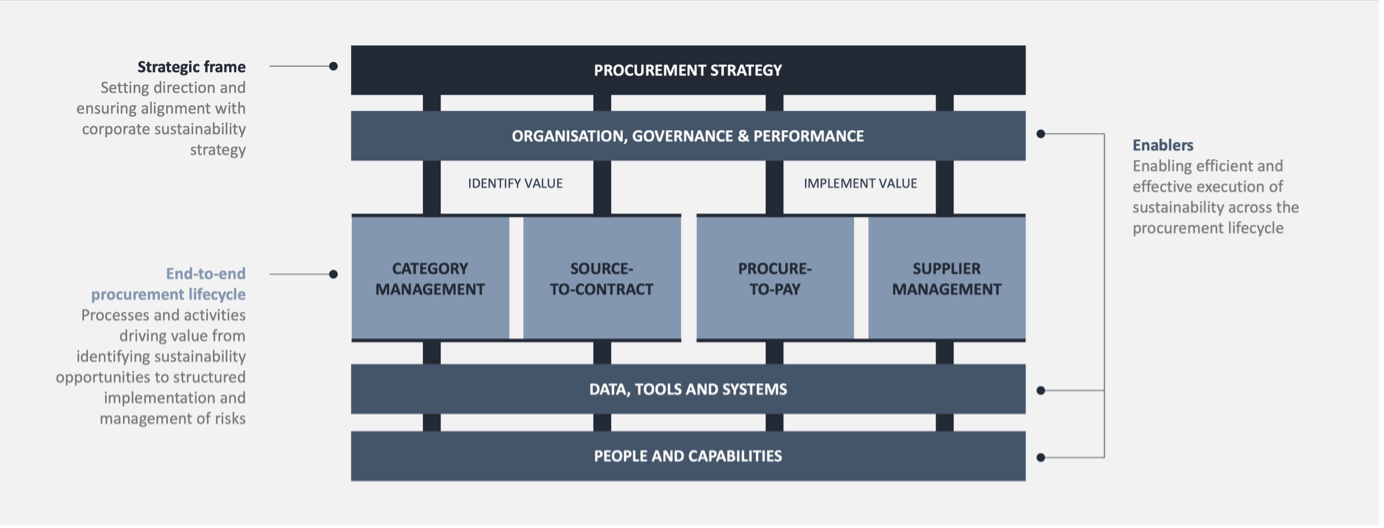
Even among well-known global players, ambition outpaced execution. No company had integrated sustainability end-to-end across the procurement cycle. Most were still managing supplier risk through a code of conduct and occasional audits, rather than the systematic risk management that tools like Responsibly are starting to enable.
Decarbonisation targets rarely came with the consequence or incentive models needed to move suppliers. And nearly every company pointed to the same gap: systems that cannot yet handle the scale of data sustainability integration requires.
The companies furthest along shared three traits: sustainability embedded across the full procurement lifecycle rather than at isolated points, clear ownership working directly with operational procurement teams, and sustainability built into actual sourcing decision mechanics rather than treated as a compliance check.
Maersk’s shift from compliance to impact with Responsibly
Carlos Reyes Le Paliscot described the challenge Maersk was solving for: a net-zero commitment and 14 ESG topics to manage across a supplier base that keeps growing through acquisitions.
The old process ran on Excel questionnaires, with a long wait for supplier responses and a small team working through thousands of assessments, each one loaded with dozens of questions and documents, often in other languages.
The AI-powered due diligence system
What Responsibly does is automate due diligence using AI and agents. Building the system on AI allows companies to navigate complex legislations and topics at the scale needed to get a hold of the long tail of the supply chain.
By working with Responsibly, Maersk now uses a model that gathers public information, reports and third-party data to build an initial profile of each supplier without any interaction. That analysis now takes about a week, with results back within five days rather than the six weeks it used to take when the work was done manually. For the first time, Maesk has full baseline visibility across its Tier 1 base of approximately 60,000 suppliers.
This has freed the team to move from data collection to focus on transformation and category engagement, with quality review now flag-driven rather than document-checking.
Technology moves the ceiling, embedding sustainability runs through people and governance
Both Carlos and Thomas were clear that removing the assessment bottleneck is only step one. Their shared conclusion was how the assessment challenge is genuinely solvable at scale with the right tools, but the harder and longer work, embedding sustainability into category strategy, sourcing decisions and supplier engagement, still runs through people and governance. This conclusion is one we share at Nordic Sustainability, and one that was clearly visible in our benchmark.
Nordic Sustainability supports leading companies integrating sustainability into procurement
If you’d like to discuss where your procurement organisation stands or see the full benchmark findings, reach out to Sven Beyersdorff at sbe@nordicsustainability.com.
Author details
Sven Beyersdorff
Managing Partner