Forced labour affects around 28 million people worldwide, most of them in private sector supply chains, according to the International Labour Organization. Migrant workers face three times the average risk, and five sectors alone: services, manufacturing, construction, agriculture and domestic work, account for 87 percent of adult cases.
This is not a distant problem, as fifteen percent of global cases occur in Europe and Central Asia, including recent cases involving luxury fashion subcontractors in Italy, a berry-picking operation in Finland, and a construction site at the port of Antwerp.
The EU Forced Labour Regulation represents a significant shift in how the EU approaches supply chain accountability. This webinar unpacked what the EUFLR is and how companies can prepare ahead of the December 2027 enforcement deadline. The session featured:
- Anniina Kristinsson, CEO at Nordic Sustainability
- Saara Salonoja, Associate Manager at Nordic Sustainability
A rising tide of regulation is reshaping value chain management
Forced labour rules are one part of a wider regulatory shift.
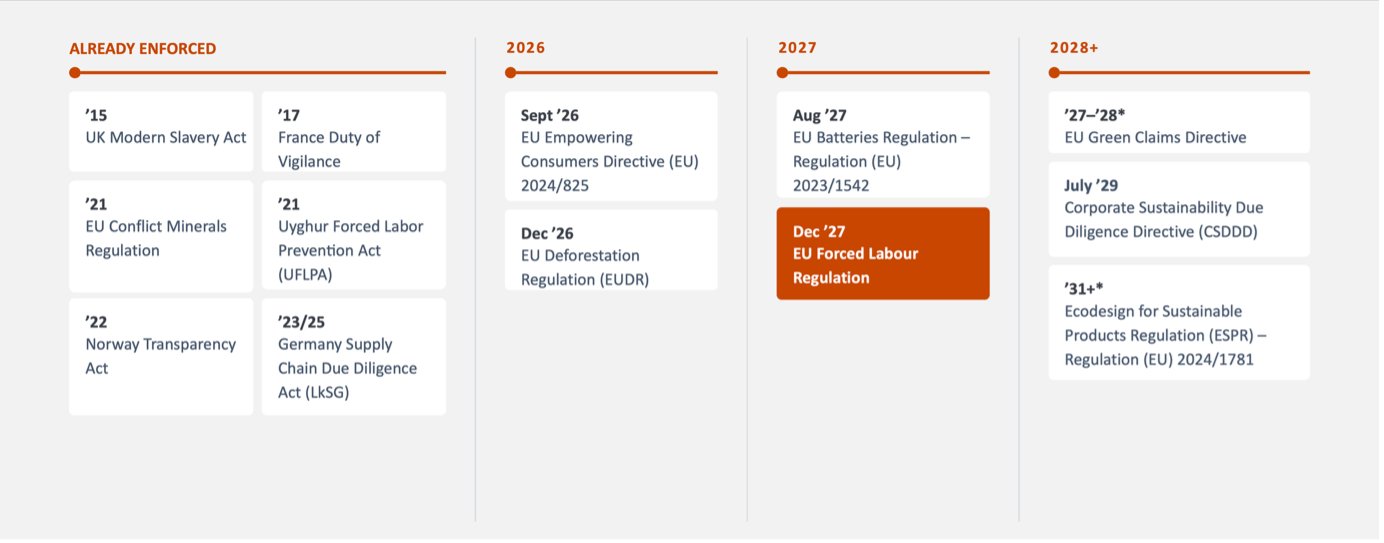
National due diligence acts, such as the UK Modern Slavery Act, and the US import ban are already in force, and a series of new EU directives is set to land by 2027.
All of them rest on the same foundation: value chain traceability and supplier due diligence. Building that foundation properly once allows companies to meet several requirements at the same time.
The EU Forced Labour Regulation unpacked
The EUFLR is a product-level ban, not a company-level sanction. It prohibits placing, making available on, or exporting from the EU market any product made wholly or partly with forced labour, at any stage of production.
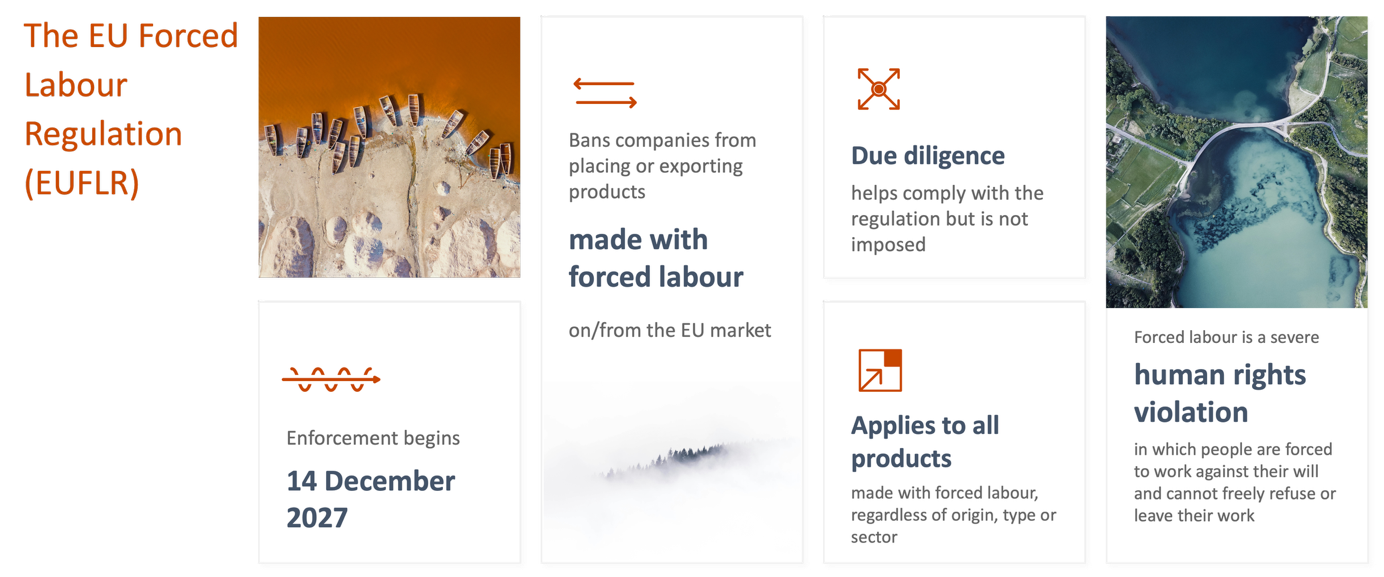
This applies across all sectors, with no minimum threshold. Online sales targeting EU end users are also in scope. Products already sold to end users are not covered, and services (including product-related services such as transport, warehousing, logistics) sit outside the regulation entirely.
How an investigation works
The regulation does not itself create a due diligence obligation, but authorities will weigh a company’s due diligence when deciding whether to investigate, which makes good practice the strongest available defence.
Authorities prioritise cases using two sets of criteria:
- On the product side: the scale and severity of suspected forced labour, and how large the sales volume and affected component are.
- On the company side: its proximity to the issue, its size, and the complexity of its supply chain.
Once a preliminary concern is raised, companies typically have 30 to 60 working days to respond with evidence. Authorities then aim to reach a decision within around nine months. If a ban follows, companies get 30 working days to comply, or 10 for perishable goods.
Two EU resources will support this process, an EU Forced Labour Risk Database and a public submission portal, but neither is live yet.
What information are we still waiting on?
Penalties are set nationally and are due to be defined by member states by December this year. There is no precedent yet for what level of documentation satisfies an investigation, and questions like how gaps in traceability affect scope remain open. These will only be settled through enforcement practice.
What to do now
With EUFLR enforcement fast approaching, companies can start preparing with five practical steps.
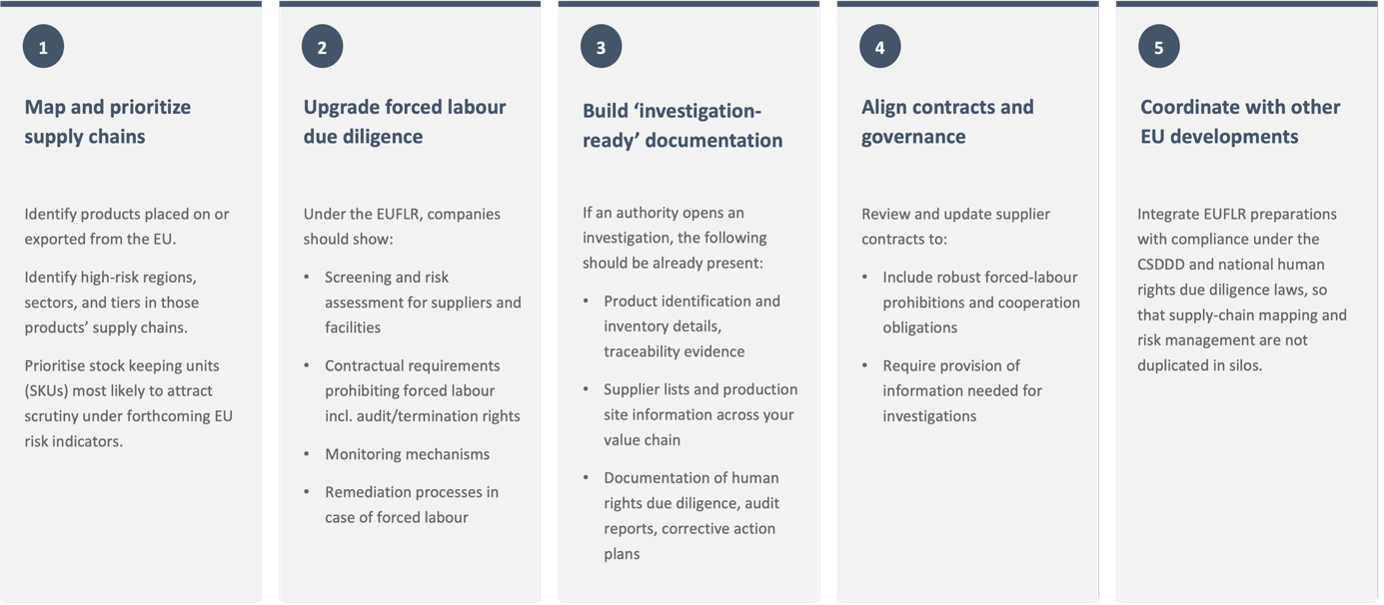
Nordic Sustainability typically starts with a short maturity assessment across governance, risk, traceability, supplier engagement and response readiness to help companies identify their biggest gaps and prioritise a roadmap.
The takeaway
Nobody, including regulators, has full clarity yet on what “enough” looks like under the EUFLR. But the capabilities it demands are not unique: visibility beyond tier one suppliers, documented due diligence, and the ability to respond quickly to an inquiry. These overlap with other due diligence regimes, so building them now is the most efficient path to being ready.
Nordic Sustainability supports companies in assessing EUFLR maturity based on existing due diligence processes and product traceability. If you would like to understand how the EUFLR might impact your company, reach out to Anniina Kristinsson or Saara Salonoja to discuss.
Author details
Anniina Kristinsson
CEO/Managing Partner

Saara Salonoja
Associate Manager