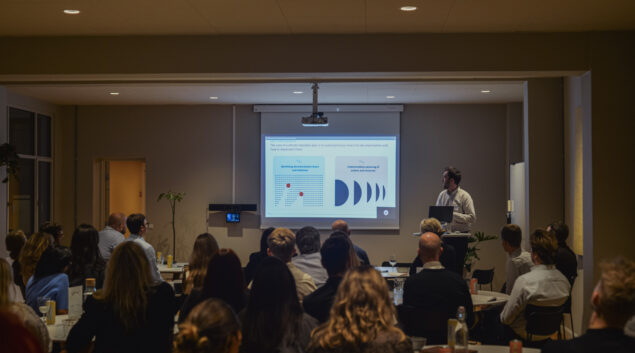
On November 5th, Nordic Sustainability gathered climate professionals for an interactive session on what defines an effective climate transition plan and how companies can put it into practice. This article summarises the main themes and reflections from the event.
The speakers featured Astrid Birk Nicolajsen, researcher and author at DTU, Morten Storgaard, Associate Director for Corporate Environmental Strategy at Novo Nordisk and Eamon Murphy, Climate Associate Manager at Nordic Sustainability.
The discussion was opened by Esben Lanthén, Co-Founder and Partner at Nordic Sustainability.
Introduction to climate transition planning
Opening the session, Esben Lanthén outlined the growing momentum behind climate transition planning. In just 18 months, the number of companies setting near-term science-based targets has nearly doubled, while those committing to both near-term and net-zero targets have increased by 227%.

Despite the strong headwinds that sustainability is facing – companies are still signing up to ambitions climate targets – showing that now more than ever we need to couple that ambition with real reductions in emissions. In short, the challenge ahead is not setting targets but delivering on them.
Insights from recent research on climate transition plans
Astrid Birk Nicolajsen, researcher and author at DTU, presented findings from the study Decoding Corporate Climate Transition Plans. Her research examined 14 of the most influential transition planning frameworks, translating more than 1,400 individual data points to compare how they define and evaluate corporate transition plans.
Astrid highlighted that while frameworks differ in focus, they converge on what needs to be included: transparent emissions accounting and target setting, demonstrating how the strategies were chosen, measurable actions aligned with financial decisions, and clear governance.

So, what does this mean in practice for companies?
- A climate transition plan is more than a checklist of data points. It connects targets, strategies, financial alignment, governance, and internal capabilities into one coherent plan for action.
- When these elements are mapped together, it becomes easier to identify strengths and gaps – for instance, where strategy is clear but financial alignment or internal roles need further work.
- Ultimately, a transition plan only matters if it is implemented. It must be embedded in core business planning and decision-making to drive real progress.
Yet, her research also revealed a structural misalignment. Traditional long-term business strategies often look 5–10 years ahead, yet achieving long-term climate goals demands a far broader horizon, one that includes investing in infrastructure, transforming value chains, and adopting circular business models.
To bridge this gap, companies must plan beyond current horizons and embed climate objectives into everyday business decisions.
Driving decarbonisation across Novo Nordisk’s value chain
Morten Storgaard, Associate Director for Corporate Environmental Strategy, presented how Novo Nordisk is translating ambition into tangible action.
Novo Nordisk has committed to net-zero emissions by 2045, with clear milestones: zero Scope 1 and 2 emissions by 2030 and a 33% reduction in Scope 3 by 2033. Currently, 96% of Novo Nordisk’s footprint lies in Scope 3, underscoring the need to engage suppliers and reduce emissions throughout the value chain.
Novo Nordisk’s decarbonisation roadmap for Scope 3 is guided by six key tracks that integrate sustainability into every aspect of its operations.

These tracks encompass both direct and indirect actions, investments and approaches to reduce raw material demand.
Morten highlighted that focus on collaboration and system-wide action is essential for achieving impact. By embedding CO₂e considerations into procurement and product development, Novo Nordisk ensures that sustainability becomes an active part of everyday operations.
Inside a credible climate transition plan
Eamon Murphy, Climate Associate Manager at Nordic Sustainability, focused on how companies can operationalise their transition plans.
A climate transition plan is not a static document, but one part of a multi-year process with critical steps for successful decarbonisation. Eamon outlined seven key steps for companies to achieve their emissions reduction targets.
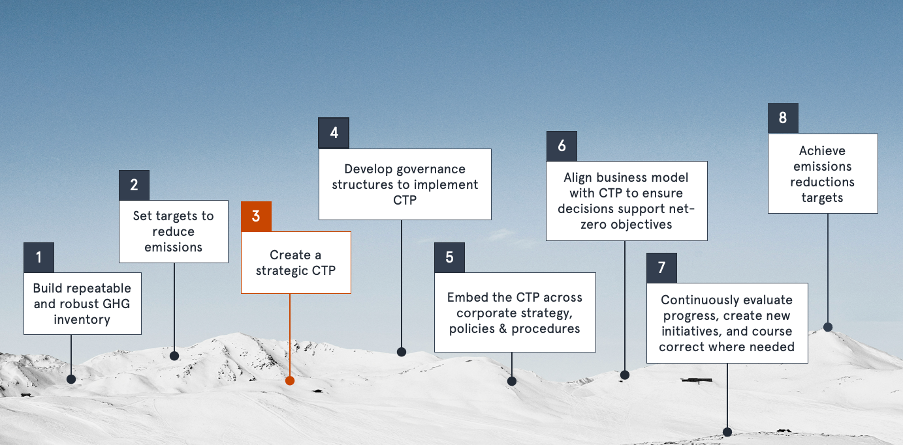
He also walked participants through ten requirements from the ESRS, highlighting that even as regulatory details on the CSRD evolve, these elements form a practical checklist for credible plans.
Eamon concluded with a reminder of urgency: to be in line with 1.5 degrees, the SBTi tells us that we need to reduce absolute emissions by 42% between 2020 and 2030. The longer you wait, the faster you must move.

Want to get started?
Nordic Sustainability supports companies in developing and implementing credible climate transition plans, from identifying emission hotspots and prioritising initiatives to securing management buy-in and operationalising impact.
The process combines data-driven analysis with collaboration across key teams to ensure that climate ambition translates into measurable results.
Reach out to our Climate Lead Ole Høy Jakobsen to get started – or take your transition plan further.
Author details
Esben Samsø Lanthén
Managing Partner

Eamon Murphy
Associate Manager, Hub Lead