While the number of companies with a climate transition plan (CTP) continues to grow, implementation remains scarce. We hosted a webinar on how to move from ambition to action, including practical advice to leverage your climate transition plan.
The panel featured Ole Høy Jakobsen, Principal at Nordic Sustainability, Astrid Birk Nicolajsen, researcher and author, and Eamon Murphy, Associate Manager and CTP Lead at Nordic Sustainability.
Sustainability isn’t dead, execution is the real bottleneck
Ole challenged the recent narrative that had gained some traction that sustainability is dead. While political developments have slowed down certain regulatory initiatives, the number of organisations setting 1.5°C‑aligned targets has more than doubled in the last 18 months.
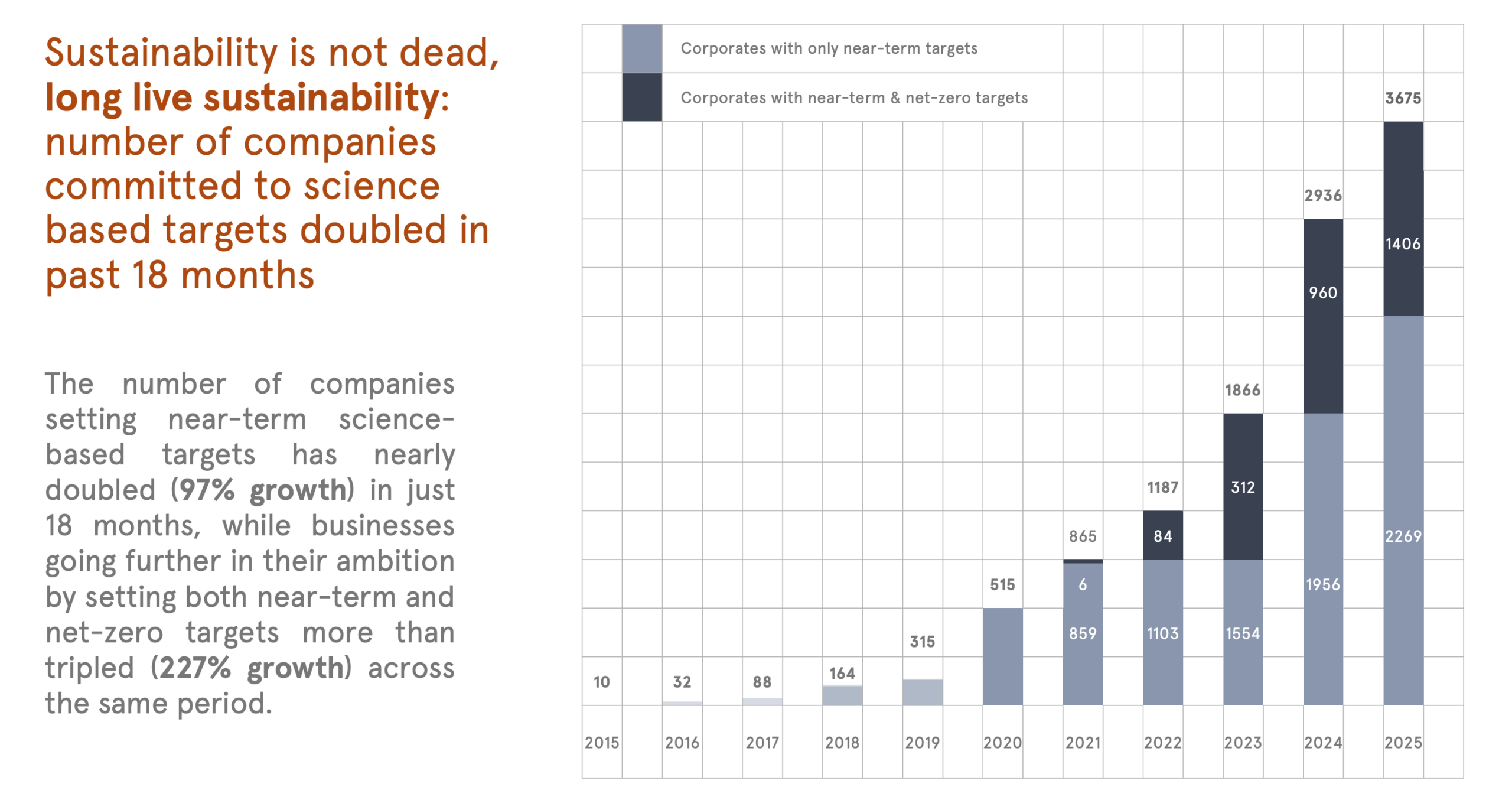
As more companies set ambitious goals, they also face the challenge of turning targets into real change. A CTP can act as the foundation for that change, but only when treated as a strategic roadmap.
As such, a good CTP is the foundation for how the transition takes place. It identifies cost savings and future revenue generation, and the most cost-efficient way to make the investments that are necessary. It consists of a great number of decarbonisation initiatives that take the company most, if not all the way towards their climate targets.
A good CTP at the very least influences a company’s development over the next 5-10 years, and companies should therefore ensure that the plan is robust, takes business realities into account and leaves room for plenty of innovation.
What we can learn from early adopters of science-based targets
Astrid presented findings from her latest study, a follow-up on her initial analysis, “Decoding Corporate Climate Transition Plans”, published in the Journal of Environmental Management in 2025. The current research investigates Denmark’s earliest adopters of science‑based targets, with a focus on manufacturing companies with significant value chain emissions.
Astrid’s research shows that while companies are reducing emissions, business ambitions towards rapid growth and profitability often offset their progress.
Even the most advanced organisations face a substantial planning gap, which leaves them struggling to quantify the final 20–40% of reductions needed to reach even short-term targets. At the core of this challenge is a misalignment between short, flexible business planning cycles and long, science‑driven horizons required for credible climate transition planning.
Without mechanisms to connect long-term climate goals to short-term operational decisions, CTPs risk remaining abstract and disconnected from daily business operations. Astrid therefore stresses that companies must move from creating two parallel plans for business and climate to a single integrated transition plan that aligns long-term climate targets with day-to-day business planning.
Inside a credible climate transition plan & practical insights for implementation
Building on Astrid’s strategic insights, Eamon zoomed in on the “how-to” of operationalising climate transition plans.
He highlighted that most companies stall because they remain stuck between easy wins (renewable electricity, efficiency measures) and the hard work (product redesign, supplier transformation, business model shifts).
A CTP fails not due to its poor design. Instead, failure often stems from a lack of ownership in implementation, insufficient time, budget, or skills within teams, and weak governance structures to ensure follow‑through.
To overcome this, companies must build the right scaffolding around their CTP:
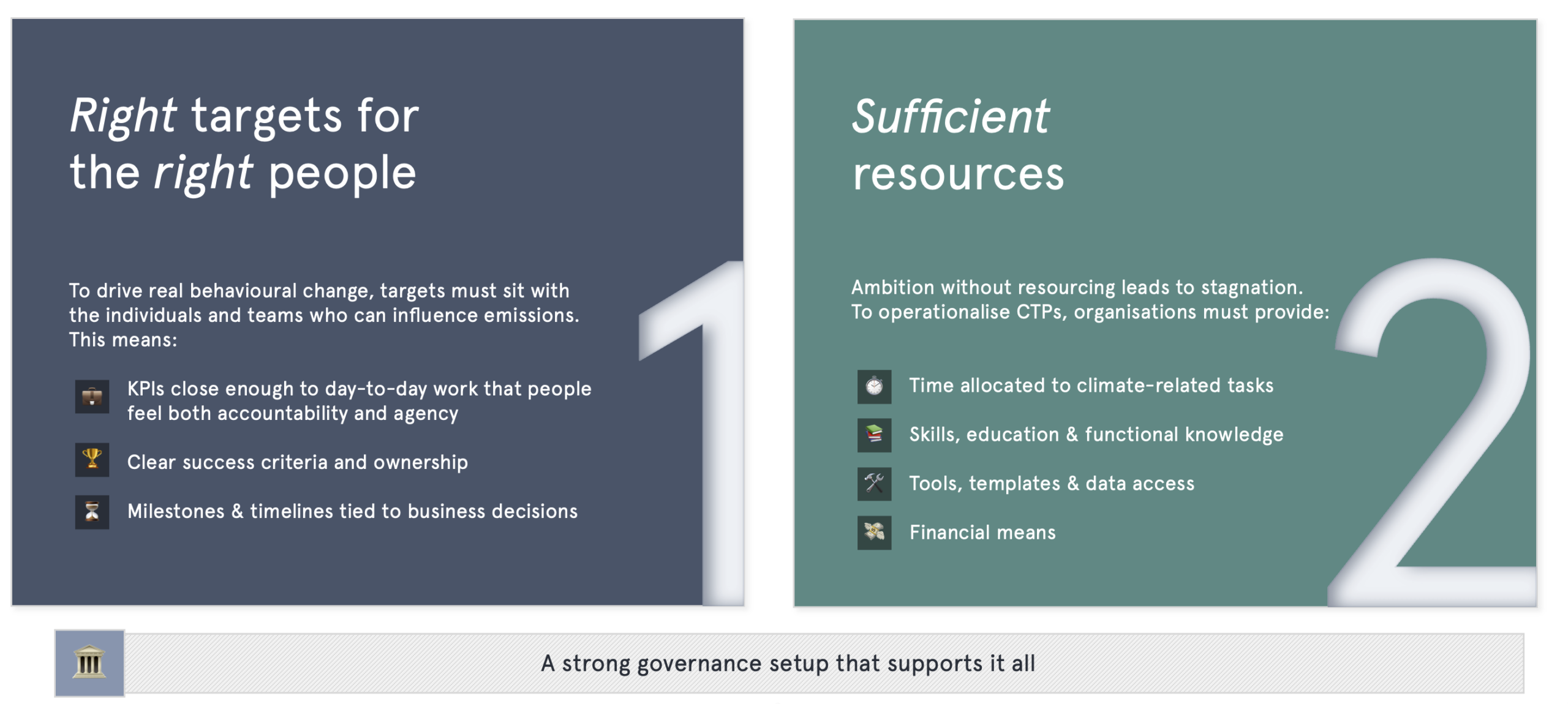
The longer companies wait to act, the faster (and more expensively) they will need to decarbonise. Instead of shifting, the window for action compresses.
A climate transition plan only creates value when it becomes part of how the business operates
The companies that succeed are those that:
- Align business and climate planning
- Quantify expected impacts and identify gaps early
- Equip teams to act, not just report
- Integrate climate into governance and incentives
- Empower sustainability teams to focus on innovation
Operationalising climate transition plans is now imperative
Nordic Sustainability supports leading companies with their decarbonisation journey. What we can help you with:
- Crafting or refining practical climate transition plans
- Building and enhancing your greenhouse gas inventory
- Setting Science-Based Targets and guiding you through the process
- Integration of climate action into daily business efforts
If you have further questions about how your organisation can develop and implement actionable climate transition plans, reach out to our CTP Lead Eamon Murphy at emu@nordicsustainability.com.
How to implement a climate tranisiton plan
In this article, we talk about climate transition plan implementation, exploring how businesses can operationalise their CTP, embed it into core strategies, and ensure measurable progress toward climate commitments.
Author details
Eamon Murphy
Associate Manager, Hub Lead

Ole Høy Jakobsen
Principal