Legislation is tightening worldwide, highlighted by China’s recent adoption of IFRS, one of the most advanced climate risk frameworks.

If 2025 was the year the world held its breath, 2026 is when it exhales. The regulatory dust is settling, the AI hype cycle is maturing, and the climate reality we have been modelling in Excel sheets is now unfolding before our eyes.
In this trend forecast, we will share what we see on the ground, in the data, and across the boardrooms of companies, redefining what it means to do business in a climate-constrained world.
What leading organisations get right
We have spent the past year deep in the trenches with organisations navigating the intricate middle ground between ambition and action. What we’ve learned is this: the companies that will thrive in 2026 are not the ones chasing every new disclosure framework or waiting for perfect clarity. It is instead the ones that take decisive action in the form of building resilience into their DNA, interrogating their value chains, and recognising that the fundamentals, unglamorous as they may be, are non-negotiable.
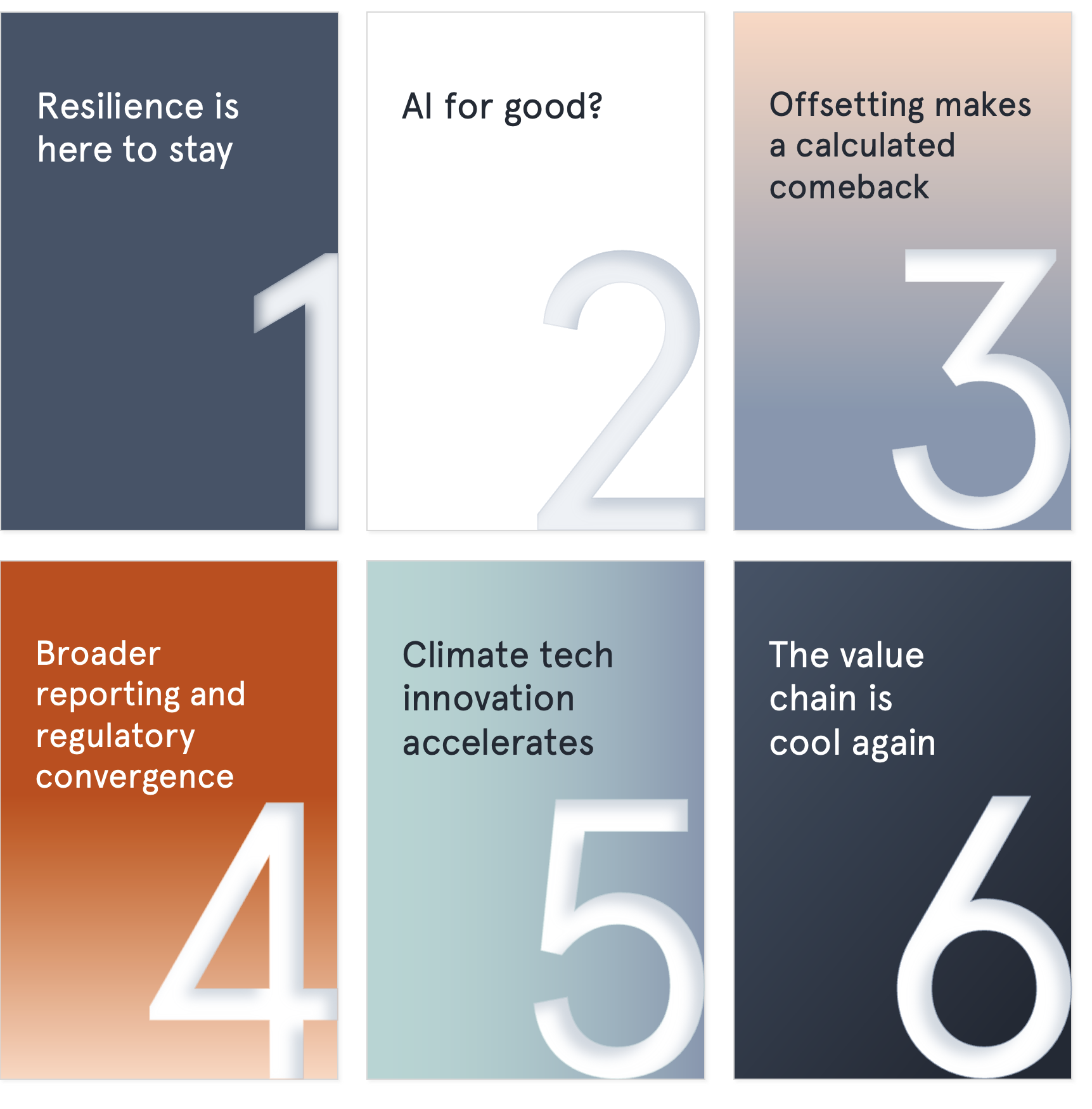
The six trends below are already shaping how forward-thinking organisations approach sustainability. Some trends will challenge you. Some may validate what you’ve suspected all along. All of them demand your attention.
Trend 1: Resilience is here to stay
Climate resilience has moved from sustainability reports to everyday business vocabulary. The term is now in each investor DD, board agenda and risk assessment, becoming table stakes faster than anticipated. Four forces are accelerating this shift:

Physical weather hazard data sets such as DEM are getting higher in quality, making future physical risks harder to downplay.

Extreme weather events are currently occurring, with 2025 already breaking records for heatwaves and flooding, proving the disturbing trend that extreme weather events are happening even ahead of what the models are predicting

Banks and investors demand more robust risk assessments for collateral, driven by forces such as the ECB climate factor and the Bank of England.
Learn more about climate risk and resilience from our experts here.
The headline here is that managing climate risks well can reduce risks and unlock new capital and potential new markets.
Trend 2: AI for good?
Today, AI is a material sustainability topic in its own right, touching everything from energy demand and emissions to labour practices, human rights and data governance.
As AI adoption speeds up, sustainability functions will more often than not be asked for their views on how AI can be used. The question facing the profession is whether responsible AI will become a new core competency, or whether sustainability will be sidelined while tech teams make decisions with massive ESG implications.
We suspect it’s the former, which means this may be the year sustainability professionals need to get fluent in AI and its trade-offs.
What companies should do is see AI as any other innovation, assess where it can help and where it might hinder, with an eyes-wide-open approach where you openly discuss trade-offs such as emissions and work slop. AI is not a blanket solution to all our problems, but rather an enabler to a few. Oh, also avoid getting locked in! We all know the tale of a 1000-1 success rate for new tech, so don’t go signing multi-year contracts only to be stuck backing the losing horse.

Trend 3: Offsetting makes a calculated comeback
As Net‑Zero pathways are revisited and scrutiny on corporate claims increases, many companies are revising their approach to carbon credits.
The emphasis is shifting toward quality over convenience and toward removals over avoidance. The rise of carbon removal credits, improved verification standards, and stricter definitions of additionality mean that offsetting in 2026 looks very different from the low-quality credits that damaged the market’s credibility. This is not a free pass to delay decarbonisation.
Yet for companies with residual emissions that are genuinely hard to eliminate, high-quality offsets are becoming a legitimate part of a credible climate strategy.
Under the draft SBTi Net-Zero Standard v2.0, companies are encouraged to engage with verified carbon removals earlier in their transition, such as direct air capture or nature-based removals, rather than limiting their use to the point when residual emissions are neutralised at Net-Zero. This is intended to signal early contribution to the market needed to achieve net-zero, but can not be used to actually lower their emissions (until Net-Zero).
The keyword here? Residual.
Offsets are for what you cannot cut, not what you have not bothered to tackle yet.

Trend 4: Broader reporting and regulatory convergence
The chaos of competing sustainability frameworks is finally giving way to something resembling order. The Corporate Sustainability Reporting Directive (CSRD)’s boundaries are being redrawn, and companies are making clearer decisions about whether to opt in or sit on the sidelines. For those in scope, there’s a newfound sense of certainty about what is required.
Broader than CSRD, China is adopting transition plans, ISSB is becoming the gold standard, and Double Materiality Assessments (DMA) are assumed as part of any rational sustainability strategy. The implication is: if you don’t have the basics in place by now, you risk being exposed.
While reporting requirements have shifted or evolved, the foundations have remained constant. GHG accounting, climate risk assessment, Net-Zero targets and climate transition plans are not going away. Being able to credibly describe and publish progress in these areas is a way to signal your commitment and improvement to potential investors and clients.
There is a silver lining. New reporting tools promise to ease the burden in the medium to long term. However, we are not there yet. At Nordic Sustainability, we have yet to see a tool that genuinely streamlines the entire reporting process end-to-end, and most currently cost more time than they save. Until those systems matured, the fundamentals still require human expertise, strategic thinking and organisational commitment.
Trend 5: Climate tech innovation accelerates despite market slowdown
Climate tech is growing and outperforming. Despite fewer deals being made overall, hitting a 4-year low, funding for climate tech actually increased by 8% in 2025.
Here are some examples of climate tech solutions within battery recycling, logistics and AI.
This means investors are getting selective, but when they find promising climate solutions, they’re writing bigger checks. The technologies that will power the low-carbon economy are still attracting serious capital. And for good reason.
The breakthroughs that decarbonisation plans have long hinged on are starting to materialise. We hope to see more progress on the technologies that tackle the hardest emissions to eliminate, such as battery recycling, low-carbon logistics and energy-efficient AI.

Trend 6: The value chain is cool again
Remember when supply chain decarbonisation was the hottest topic in sustainability? Then came regulatory uncertainty, the perceived weakening of CSDDD, and a collective putting-on-hold of Scope 3 ambitions to focus on data collection. Well, it is back.
We get approached now several times a week by companies in different sectors and countries on supply chain collaboration for decarbonisation.
Scope 1 and 2 emissions are now assumed to be in the process of being ticked off, with companies confronting the reality that their biggest climate impact, in fact, lies with their suppliers.
Clear and coordinated procurement-driven climate action will be a growing theme in 2026, and don’t forget transparency. That hasn’t disappeared either. Companies that can drive emissions reductions across their value chains will differentiate themselves, unlock new efficiencies, and build resilience against future carbon pricing.
Impact in 2026 is built on a few decisive choices
- Anchor climate resilience in core risk management and capital allocation.
- Start exploring upcoming technology solutions as they are nearly here
- Treat AI as both an operational opportunity and a sustainability topic, with clear governance, guardrails and accountability.
- Tighten offset strategies around high‑integrity credits while accelerating real‑economy emissions reductions.
- Invest in permanent reporting muscle, such as data, controls, and internal expertise, rather than hoping technology alone will “solve” compliance.
- Build value‑chain coalitions that move suppliers, customers and financiers in the same direction, especially in harder‑to‑abate sectors.
The organisations that treat 2026 as a consolidation year, locking in fundamentals, doubling down on resilience and using innovation where it really shifts the needle, will be the ones still credible in 2030. Those waiting for perfect clarity will find that the market, the regulators and investors have moved on without them.

Want to get started or get further?
At Nordic Sustainability, we support organisations in building resilient sustainability strategies and turn complexity into informed action across the value chain.
If you are concerned about any of the above and looking for ways to start, reach out to Ottilly Mould, Head of Service Innovation & AI at omo@nordicsustainability.com.
Read more
- A step-by-step guide to developing a Climate Transition Plan
- Our latest webinar on climate risk assessments from our experts
- An analysis of the future of corporate sustainability strategy
- 2025 Climate Tech Investment Trends Report
- News on China’s corporate climate reporting
- An explainer on the SBTi Net-Zero v2.0 Draft
The latest in European regulatory news
We invited Ørsted and Nykredit to a live discussion to learn how the new legislative changes impact their work.
Author details
Ottilly Mould
Senior Manager, Head of Service Innovation & AI